 Seedify
 tiers for SFUND staking and sale eligibility
Seedify tiers connect qualifying SFUND staking or farming positions with token-sale access and allocation rules. The historical nine-tier system used token thresholds and pool weights; later announcements revised entry-tier requirements. Migration-era staking updates kept tiers and announced earlier, cheaper bonding-curve entry. The applicable sale format and qualifying position determine the access a wallet receives.
Tier qualification, an allocation cap and a sale purchase describe different states. A staking balance establishes an access position under the applicable rules; purchasing project tokens involves a separate commitment to the offering.
Key takeaway: Under the legacy nine-tier allocation formula, whitelisted participant weights jointly determined each wallet's purchase cap within the sale pool.
Tier qualification governs buying capacity and access to different rounds
Tier rules governed a qualifying wallet's purchase limit and access to certain rounds, alongside separate staking reward benefits. Legacy initial decentralized exchange offerings (IDOs) used pool weights to distribute buying capacity. Tiers 6 to 9 added private-round access. Seed Club prioritized Tier 9 for seed rounds, with remaining allocation potentially offered to other high brackets. Staking and farming both supplied qualifying SFUND positions in the early launchpad model; farming credit concerned the SFUND holdings within the position. Incubation-related token rewards and the right to buy a sale allocation were separate entitlements, even when the same SFUND position contributed to both.
Pool weight divides the sale pool among whitelisted wallets
A pool weight expressed a whitelisted wallet's relative allocation share in the legacy nine-tier model. Each tier's whitelisted participant count multiplied by its weight contributed to the total pool shares. The legacy formula divided the available sale allocation by the combined pool shares of whitelisted participants to calculate allocation per pool share.
The allocation denominator
Weight per wallet
A whitelisted wallet's tier weight then scaled its individual allocation. A weight represented relative buying capacity, without fixing a dollar purchase cap.
Number of whitelisted participants
More whitelisted participants increased the denominator. With an unchanged sale pool and weight schedule, that increase reduced the allocation per wallet.
Guaranteed allocation described access to a calculated share. The sale pool still bounded that share's size.
Historical thresholds distinguish lottery entry from higher-tier privileges
The earlier three-tier design assigned separate allocation pools to its brackets. The August 2021 nine-tier schedule used combined pool weights. Tier 1 required fewer SFUND tokens and used lottery selection. Tier 2 offered guaranteed allocation with a larger qualifying holding. Their difference concerned predictable access and the capital required to qualify. Higher brackets increased pool weight and added particular round privileges. These historical terms explain legacy allocation records, rather than establishing a live staking schedule.
| Historical tier | Access in the August 2021 model | Required SFUND holding |
|---|---|---|
| Tier 1 | Lottery allocation; pool weight 1.2 | 250 SFUND |
| Tier 2 | Guaranteed allocation; pool weight 2 | 1,000 SFUND |
| Tier 6 | Guaranteed allocation and private-round access; pool weight 26 | 10,000 SFUND |
| Tier 8 | Guaranteed allocation and private-round access; pool weight 150 | 50,000 SFUND |
| Tier 9 | Guaranteed allocation, private-round access and Seed Club eligibility; pool weight 325 | 100,000 SFUND |
The same schedule placed Tier 3 at 2,500 SFUND with weight 5.5 and Tier 4 at 5,000 SFUND with weight 12. Tier 5 required 7,500 SFUND with weight 19; Tier 7 required 25,000 SFUND with weight 70. A pool weight measured relative allocation, while the SFUND threshold measured the holding needed for that bracket.
The May 2023 tier update announced guaranteed Tier 1 allocation at 500 SFUND. It specified revised pool weights of 1.1, 2.2 and 5.8 for Tiers 1, 2 and 3 respectively. Combining those revised weights with the earlier lottery requirement would mix different tier-system versions. Neither schedule specifies a universal bonding-curve price for each tier. The update also announced a six-month transition for existing 250 SFUND Tier 1 holders, with a 50% lottery chance before each IDO.
What qualified a wallet for a legacy Seedify IDO?
Approved know-your-customer (KYC) verification and qualifying tokens staked 24 hours before the event were prerequisites for the V2 IDO whitelist. Tier 1 also required a lottery win. Seedify shared the whitelist before each IDO. Its terms also excluded residents of specified jurisdictions, including the United States and China. Meeting a token threshold did not waive those conditions. The advance-staking requirement concerned sale qualification; it did not define the staking pool's lock duration.
Earlier bonding-curve access changes the entry-price opportunity
Earlier tier access can affect bonding-curve entry prices because purchases advance the curve and increase the price. The Seedify Vibecoins design included whitelisted SFUND tier access. A later migration-era announcement reported SFUND staking live, with earlier and cheaper bonding-curve entry among its benefits. That benefit did not establish a fixed discount percentage for every tier. A legacy pool weight described relative buying capacity; a curve price described the purchase cost at one stage of a raise. The entry window therefore matters alongside the curve terms and available sale capacity.
Earlier access alone does not establish the eventual trading price or the amount available when purchased tokens unlock.
Legacy staking kept tier credit without immediate migration
The SFUND migration update kept existing old-token staking positions in the total tier calculation. That credit addressed qualification while a position remained in its legacy pool. The update also kept staking tiers unchanged, so the replacement token launch did not itself imply a new tier ladder.
The migration terms allowed holders to migrate once their current pool matured. Counting a position toward a tier did not make its locked SFUND immediately available for transfer.
Eligibility also depended on when a holder obtained legacy SFUND. The migration announcements excluded old SFUND bought on decentralized exchanges after 10 AM UTC on October 9, 2025. The replacement SFUND launch used BNB Chain, with a different contract from the legacy token. Sharing the SFUND ticker did not make those contracts interchangeable or turn later old-token purchases into eligible migration holdings.
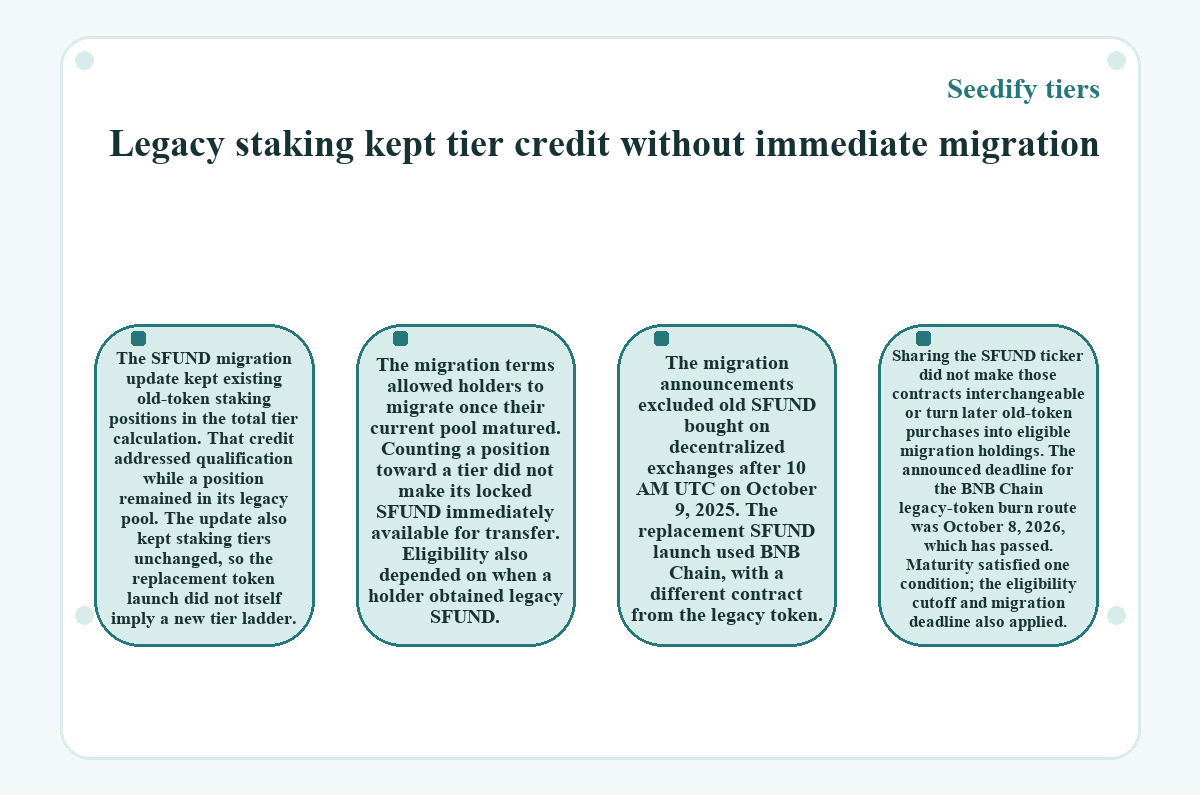
The announced deadline for the BNB Chain legacy-token burn route was October 8, 2026, which has passed. Maturity satisfied one condition; the eligibility cutoff and migration deadline also applied.
Staking and sale purchases create separate capital commitments
A qualifying SFUND position commits access capital, while a token purchase commits additional capital to the chosen offering. Under a token-denominated tier schedule, qualification uses SFUND quantity. Its market value can change while that quantity stays constant. A larger holding may qualify for a higher bracket; allocation rules determine additional buying capacity. Staking locks cover SFUND, while sale vesting restricts purchased project tokens. A larger tier does not make either asset immediately liquid. You can compare brackets before committing SFUND to a staking lock.
A qualifying tier granted private-round access, while each offering determined its purchase price and token release. In the August 2021 schedule, that additional access began at Tier 6's 10,000 SFUND requirement.
Key questions about Seedify tiers
Can SFUND on a centralized exchange qualify my launchpad wallet?
An exchange balance alone did not qualify the wallet used in the legacy launchpad process. Participation required the wallet supplied during KYC to match the wallet interacting with the sale contract. The qualifying position therefore concerned that wallet, rather than an unrelated custodial account showing an SFUND balance.
Does the entire value of a farming deposit count toward an SFUND tier?
The early launchpad rules counted SFUND holdings within liquidity-pool farming positions toward tier qualification. That measure concerned the SFUND component, rather than treating the entire deposit's market value as an SFUND token count.
Is a seed staking point multiplier the same as a tier pool weight?
A seed staking point multiplier and a tier pool weight govern different calculations. The Seed Staking Boosters interface applied lock-related multipliers to point generation per SFUND. The legacy tier model used pool weights to divide a sale allocation among qualifying participants. A point multiplier therefore does not establish a new sale allocation weight or change a tier threshold by itself.
How did unsold tokens affect the legacy reserved allocation?
Unsold tokens could enter a second, first-come-first-served round after the V2 IDO model's reserved purchase window, which lasted two hours from the IDO's start. The V2 IDO model used the same whitelist for that round. A first-round reservation did not guarantee a second-round purchase.
Are legacy farming rewards received after the migration cutoff eligible for migration?
Old-token farming rewards obtained after 10 AM UTC on October 9, 2025, were ineligible for migration. The exclusion concerned newly received SFUND rewards. Tier credit for an existing old-token staking position addressed a separate qualifying balance, so that credit did not confer migration eligibility on later farming rewards. The announced deadline for the BNB Chain legacy-token burn route was October 8, 2026, which has passed.